
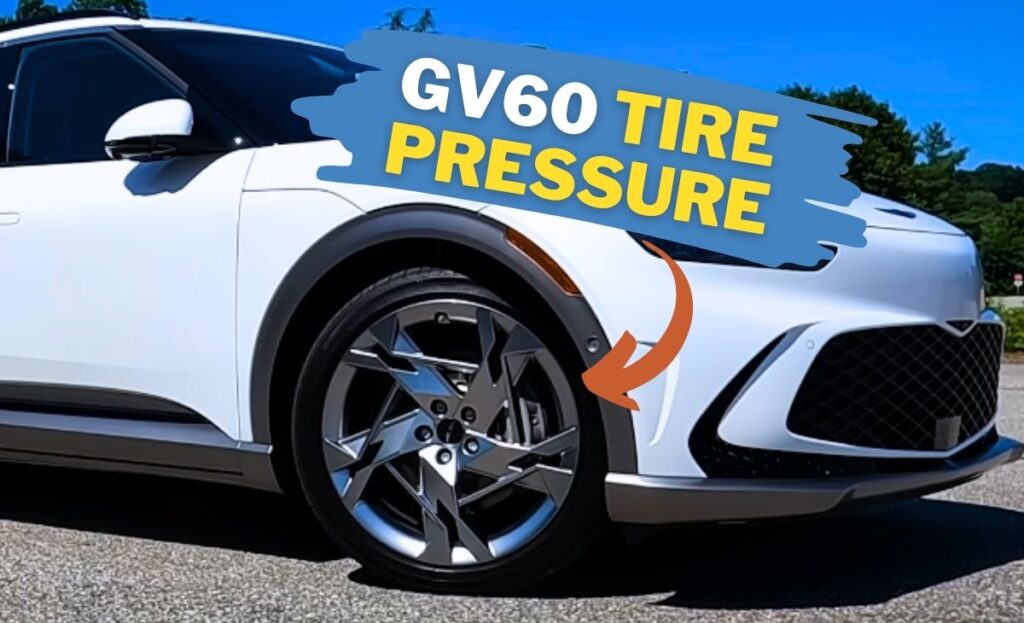
Are you wondering why tire pressure is such a big deal for your Genesis GV60? It’s scary when you are cruising down the road, enjoying a smooth and comfortable ride, but suddenly, you hit a bump and lose control of your vehicle. However, maintaining the correct tire pressure can prevent this nightmare scenario and much more. In this blog, we’ll talk about GV60’s recommended tire pressure.

Genesis GV60 recommended tire pressure.
Usually, all Genesis models’ recommended tire pressure is 33 to 39 PSI, and the gv60’s recommended tire pressure is 36 to 39 PSI. For most Genesis GV60 models, including the standard and premium trims, the recommended tire pressure is around 37 PSI for all four tires. To ensure optimal performance, safety, and fuel efficiency, it is crucial to maintain the recommended tire pressure.
Suggested Others Genesis Tire Pressure
There are so many models of Genesis cars, such as G70, G80, G90, GV60, GV70, and GV80. Here are the suggested tire pressures for different models:
- G70 Pressure: 36 to 39 PSI
- G8O Pressure: 33 to 38 PSI
- G90 Pressure: 35 PSI
- GV70 Pressure: 33 to 39 PSI
- GV80 Pressure: 33 to 38 PSI
What is PSI?
We already know that the standard tire pressure for gv60 is 37 PSI. Now, the question is, what is PSI? PSI means “pounds per square inch,” and it is a unit of pressure commonly used in the measurement of tire pressure. In the context of a car’s tire pressure, PSI represents the force exerted by the air inside the tire on each square inch of the tire’s internal surface.
Where is the correct tire pressure located?
The manufacturer typically specifies the correct tire pressure for a vehicle, which can be found in several places. One common location is on a sticker inside the driver’s door. It’s also usually found in the owner’s manual.
Tire Pressure Monitoring System
Tire Pressure Monitoring System, also known as TPMS, is a technology designed to monitor the air pressure of a vehicle’s tires in real time. The primary purpose of TPMS is to alert the driver when tire pressure falls below or exceeds the recommended levels. This system typically uses sensors mounted on each tire’s valve stem or within the tire itself to measure the air pressure.
Suppose the pressure deviates from the acceptable range. In that case, the TPMS sends a warning signal to the driver through the dashboard indicator, alerting them to check and adjust the tire pressure accordingly. TPMS plays a crucial role in enhancing safety, fuel efficiency, and overall vehicle performance by helping drivers maintain proper tire inflation levels.

Importance of Tire Pressure
Maintaining the recommended tire pressure is essential for optimal vehicle performance, fuel efficiency, and safety. Regularly checking and adjusting tire pressure helps ensure proper traction with an overall smooth driving experience. The tire pressure directly influences the handling, braking, and stability of your vehicle.
Conclusion
In summary, ensuring the correct tire pressure for your GV60 is vital for a safe and smooth ride. Refer to the owner’s manual or the driver’s side door for recommended pressure. This approach not only enhances fuel efficiency but also elevates handling and overall performance. Don’t forget this advice applies to all Genesis models. Regularly check and adjust tire pressure for a safer and more enjoyable driving experience.
FAQs for “GV60 Recommended Tire Pressure”
1. What is the recommended tire pressure for the Hyundai GV60?
The recommended tire pressure for the Hyundai GV60 typically falls in the 36–42 PSI range, depending on the trim, wheel size, and load. Always check the tire-pressure label on the driver’s door jamb or the vehicle manual for exact specifications.
2. Does the GV60 have different tire pressures for front and rear tires?
Yes, some GV60 models may require slightly different PSI levels for the front and rear tires, especially on larger wheel sizes or performance trims. Always follow the values listed on the vehicle’s sticker rather than a general estimate.
3. How often should I check tire pressure on the Hyundai GV60?
You should check your GV60’s tire pressure at least once a month, and before long trips. Electric vehicles can be more sensitive to under-inflation, which affects range, performance, and tire wear.
4. What happens if I drive my GV60 with low tire pressure?
Driving with low tire pressure can lead to reduced EV range, poor handling, longer braking distances, and uneven tire wear. Severe under-inflation can also cause overheating and potential tire failure.
5. Does the GV60 tire pressure change in cold weather?
Yes. Tire pressure naturally decreases as temperatures drop — roughly 1 PSI for every 10°F. GV60 owners often notice their TPMS warning lights during winter. Regular checks during seasonal changes are important.
6. Can I overinflate the tires on my GV60?
Overinflation can cause harsh rides, reduced traction, and faster wear in the center of the tire. Always stay within the manufacturer’s recommended PSI range to maintain safety and performance.
7. Does tire pressure affect the GV60’s driving range?
Absolutely. Under-inflated tires create higher rolling resistance, which can reduce your GV60’s electric driving range by 5–10% or more. Keeping tires at the correct PSI helps maximize efficiency.
8. How do I reset the tire pressure monitoring system (TPMS) on the GV60?
The GV60’s TPMS usually resets automatically after inflating all tires to the proper PSI and driving for a few minutes. If the light stays on, check for leaks or sensor issues, or consult a Hyundai service center.
9. Does the GV60 require different tire pressures when towing or carrying heavy loads?
If you carry heavy cargo, you may need to increase tire pressure slightly — but never exceed the maximum PSI listed on the tire sidewall. Always start with the manufacturer’s recommended values.
10. Where can I find the official GV60 tire pressure information?
You can find the official tire pressure recommendations on:
- The driver’s door jamb sticker,
- The owner’s manual, or
- The manufacturer’s website.
These are the most accurate sources for your specific trim and wheel size.