
When shopping for new tires, most drivers focus on size, brand, or price. One small detail often overlooked is a single letter printed on the tire sidewall—the speed index. That letter plays a critical role in your vehicle’s safety, handling, and long-term performance.
If you’ve ever wondered:
- What does the speed index on a tire actually mean?
- Is a higher speed rating always better?
- Can you choose a different speed rating than your factory tires?
- How do you read a speed index tires chart correctly?
This guide answers all of that—clearly, practically, and without jargon.
By the end, you’ll know exactly how to use a speed index tires chart to choose the right tire for your driving style, vehicle type, and real-world conditions.
What Is a Speed Index on Tires?
The speed index (also called the tire speed rating or speed symbol) indicates the maximum speed a tire can safely sustain under specific test conditions.
It’s represented by a letter, such as S, T, H, or V, and is part of the tire’s full size code printed on the sidewall.
Example Tire Code:
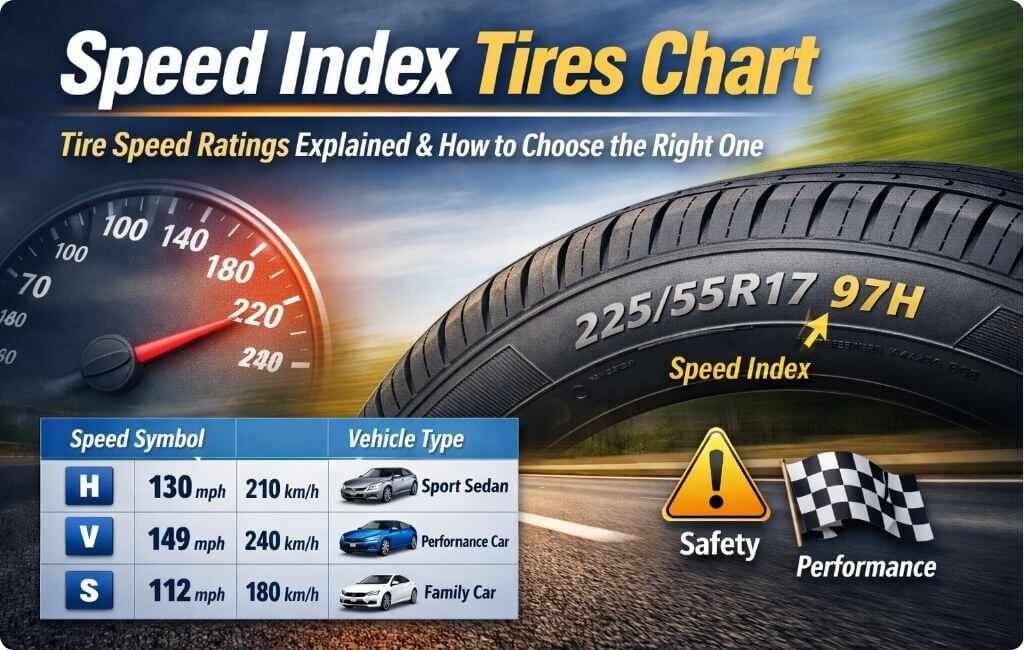
225/55R17 97H
- 225 – Tire width (mm)
- 55 – Aspect ratio
- R – Radial construction
- 17 – Wheel diameter (inches)
- 97 – Load index
- H – Speed index
In this example, the letter H tells you the tire is rated for speeds up to 130 mph (210 km/h) under controlled conditions.
What the Speed Index Really Measures (And What It Doesn’t)
A common misconception is that speed ratings are only about how fast you plan to drive. In reality, they’re more about heat management and structural integrity.
During testing, tires are:
- Properly inflated
- Correctly loaded
- Run at increasing speeds on a test drum
- Evaluated for heat buildup, stability, and durability
The faster a tire rotates, the more heat it generates. A higher speed rating means the tire can:
- Withstand higher temperatures
- Maintain stability under stress
- Offer better high-speed handling
Important:
A speed rating does not mean you should drive at that speed. It only indicates the tire’s tested capability under ideal conditions.
Speed Index Tires Chart (mph & km/h)
Below is a commonly used speed index tires chart that helps translate those letter codes into real-world meaning.
| Speed Index | Max Speed (mph) | Max Speed (km/h) | Typical Vehicles |
| L | 75 mph | 120 km/h | Off-road, trailers |
| M | 81 mph | 130 km/h | Temporary spares |
| N | 87 mph | 140 km/h | Older passenger cars |
| P | 93 mph | 150 km/h | Light-duty vehicles |
| Q | 99 mph | 160 km/h | Winter tires, SUVs |
| R | 106 mph | 170 km/h | Light trucks |
| S | 112 mph | 180 km/h | Sedans, minivans |
| T | 118 mph | 190 km/h | Family cars |
| H | 130 mph | 210 km/h | Sport sedans |
| V | 149 mph | 240 km/h | Performance vehicles |
| W | 168 mph | 270 km/h | High-performance cars |
| Y | 186 mph | 300 km/h | Sports cars |
How to Read a Speed Index Tires Chart Correctly
A speed index chart is not about choosing the highest number—it’s about choosing the right rating for your vehicle and driving habits.
Key Things to Understand:
- The letter is more important than the number
- Each step up often changes tire construction
- Higher ratings usually mean:
- Stiffer sidewalls
- Better handling
- Shorter tread life
- Higher cost
- Stiffer sidewalls
Real-World Example:
A driver who never exceeds highway speeds doesn’t automatically benefit from a V-rated tire compared to an H-rated tire. In many cases, the H-rated tire offers:
- Better ride comfort
- Longer tread life
- Lower cost
What Speed Index Should You Choose?
1. Follow the Manufacturer’s Recommendation
Your vehicle manufacturer selects a speed rating based on:
- Suspension tuning
- Weight distribution
- Intended performance
- Safety margins
You can find the recommended speed rating:
- In the owner’s manual
- On the driver-side door jamb sticker
General rule: You should never install tires with a lower speed rating than recommended unless explicitly allowed (such as certain winter tires).
2. Choose Based on Your Driving Style
City & Daily Commuting
- Typical speeds: low to moderate
- Priority: comfort, durability, fuel efficiency
- Common ratings: S or T
Highway & Long-Distance Driving
- Sustained speeds
- Heat buildup matters
- Common ratings: T or H
Sporty or Aggressive Driving
- Quick acceleration
- Sharp cornering
- Common ratings: H, V, or W
3. Speed Index by Vehicle Type
Sedans
Most modern sedans perform best with T or H ratings.
SUVs & Crossovers
Often rated H or V, especially heavier or performance-oriented models.
Trucks & Vans
Speed rating may be lower, but load index becomes critical.
Performance Cars
Designed for V, W, or Y ratings to maintain stability at high speeds.
Higher vs Lower Speed Ratings: Pros and Cons
Benefits of Higher Speed Ratings
- Improved steering response
- Better high-speed stability
- Enhanced cornering grip
Trade-Offs
- Firmer ride
- Increased road noise
- Faster tread wear
- Higher replacement cost
Key insight: Higher speed ratings are about capability, not necessity.
Common Speed Index Tire Mistakes
- Assuming higher is always better
- Mixing different speed ratings on one vehicle
- Ignoring speed index when buying used tires
- Choosing a lower rating to save money
- Confusing speed rating with speed limit
Any of these mistakes can negatively affect:
- Handling
- Braking
- Stability
- Insurance coverage
Can You Change Tire Speed Rating from Stock?
Upgrading the Speed Rating
Generally acceptable and often improves handling, as long as:
- Tire size remains correct
- Load index is maintained
Downgrading the Speed Rating
May be allowed in limited cases:
- Winter tires (often Q or T rated)
- Manufacturer approval required
- Must be clearly labeled in some regions
Insurance & Warranty Considerations
Installing tires with a lower speed rating than OEM can:
- Void warranties
- Affect insurance claims after accidents
Speed Index vs Load Index: Don’t Confuse Them
The load index indicates how much weight a tire can safely carry. Both ratings must be considered together.
Example: A tire with a high speed rating but insufficient load index is not safe, especially for SUVs and trucks.
Rule: Never compromise load index for speed rating.
Winter Tires and Speed Index
Winter tires often have lower speed ratings because:
- Softer rubber compounds
- Deeper tread designs
- Focus on traction, not speed
This is normal and acceptable if approved by the vehicle manufacturer.
Expert Tips for Choosing the Right Speed Index Tires
- Match the rating to how you actually drive
- Follow OEM recommendations whenever possible
- Balance comfort, performance, and longevity
- When in doubt, consult a tire professional
Final Thoughts: Using a Speed Index Tires Chart with Confidence
A speed index tires chart is more than a reference—it’s a safety and performance guide. Understanding it helps you:
- Make smarter buying decisions
- Avoid costly mistakes
- Improve vehicle handling and comfort
- Drive with confidence in all conditions
Before your next tire purchase, take a moment to check that small letter on the sidewall. It matters more than most drivers realize.
FAQs
What if I can’t find the OE speed rating?
Use the vehicle manual or contact the dealer. If still unsure, match the general performance class (e.g., family sedan = S/T).
Can I mix speed ratings on the same axle?
Ideally no. Mixing different speed ratings (and tread types) on the same axle can affect handling. If mixing is unavoidable, consult a pro.
Do speed ratings affect tire warranty?
Possibly. Some warranties or fitment guarantees assume correct replacement ratings. Always read the warranty fine print.
Are speed index charts universal?
The letter→speed mapping is generally consistent across manufacturers for common codes, but always check the manufacturer technical data for Z/ZR/Y and specialty tires.