
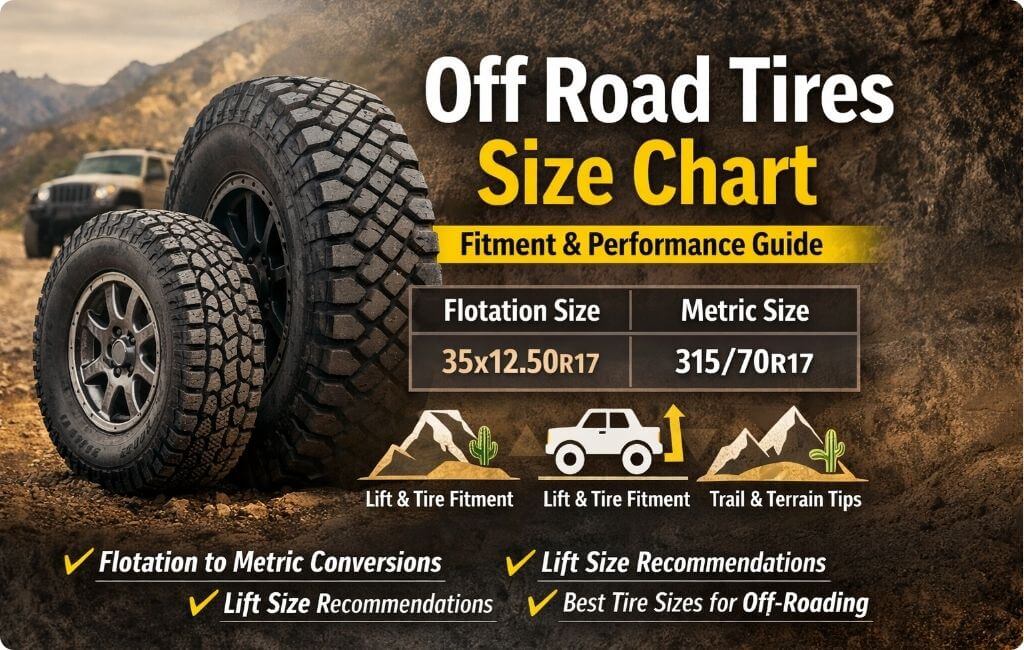
Off Road Tires Size Chart
Last updated on February 16th, 2026
Choosing the right off-road tire size isn’t just about looks—it directly affects your vehicle’s performance, safety, fuel economy, and trail capability. If you’ve ever felt confused by tire sizing formats like 35×12.50R17 or 315/70R17, you’re not alone.
This guide breaks everything down in simple terms and includes a clear off road tires size chart to help you confidently choose the right tire size for your SUV, truck, or 4×4—without rubbing issues, wasted money, or guesswork.
Who This Off Road Tires Size Chart Is For
If you’ve ever looked at off-road tire sizes and thought, “What do these numbers even mean?”—you’re not alone. This size chart was created for real people facing real decisions, not tire experts or mechanics.
SUV and Truck Owners Planning Tire Upgrades
Maybe your SUV or truck came with basic factory tires. They work fine on the road, but once you hit dirt, mud, or snow, they feel limited. You want something tougher—but you don’t want tires that rub, hurt gas mileage, or make daily driving uncomfortable.
This size chart helps you see what tire sizes actually fit your vehicle, so you can upgrade with confidence instead of guessing.
Jeep and 4×4 Enthusiasts
If you own a Jeep or a 4×4, you already know how quickly tire talk can get confusing. One person says you need 35-inch tires. Another says 33s are better. Suddenly, everyone has a different opinion.
This guide cuts through that noise. It shows you which tire sizes work best for different setups, so you can choose a size that matches how you drive—whether that’s crawling over rocks or just enjoying the trail on weekends.
Beginners Confused by Tire Sizing Formats
Tire sizes can look like a secret code: 33×12.50R17, 285/70R17, 315/70R17. If you’re new to off-roading, it’s normal to feel overwhelmed.
This size chart breaks everything down in plain terms. You’ll learn what the numbers mean, how different sizes compare, and how to avoid buying the wrong tires. No technical talk—just clear answers.
Overlanders and Weekend Trail Drivers
Maybe your vehicle is your daily driver during the week and your adventure rig on the weekend. You need tires that can handle dirt roads, camping trips, and light trails—but still feel comfortable on the highway.
This chart helps you find a balanced tire size—one that gives you extra capability off-road without making your vehicle hard to live with every day.
How Off Road Tire Sizes Work
At first glance, off-road tire sizes can look confusing. They’re just numbers and letters—but once you know the story behind them, they start to make sense.
Think of tire sizes as a quick way to answer three simple questions:
How tall is the tire? How wide is it? And what wheel does it fit on?
Understanding Tire Size Formats
There are two main ways tire sizes are written. You’ll see both on this size chart.
Flotation Sizing (Example: 35×12.50R17)
This is the most common format for off-road tires.
- 35 = the tire is about 35 inches tall
- 12.50 = the tire is about 12.5 inches wide
- 17 = the wheel size it fits (17 inches)
This format is popular because it’s easy to picture. A bigger first number means a taller tire.
Metric Sizing (Example: 315/70R17)
This format is common on factory tires and many modern vehicles.
- 315 = tire width (in millimeters)
- 70 = sidewall height (as a percentage of the width)
- 17 = wheel size (17 inches)
Metric sizes take a little more math, which is why many off-roaders prefer flotation sizing.
Metric vs Flotation Size Comparison
You might wonder why both formats exist. The simple answer: different manufacturers and vehicles use different systems.
Flotation sizes are easier to visualize. Metric sizes are more precise. That’s why an off road tires size chart shows both—so you can compare them side by side and choose the size that fits your vehicle without guessing.
Once you see the sizes lined up, the confusion fades—and choosing the right tire becomes much easier.
Off Road Tires Size Chart (Flotation to Metric Conversion)
Use this table to quickly compare popular flotation sizes with their closest metric equivalents.
| Flotation Size | Approx. Metric Size | Tire Diameter (in) | Tire Width (in) | Common Rim Size |
| 30×9.50R15 | 235/75R15 | ~29.9 | ~9.3 | 15” |
| 31×10.50R15 | 265/75R15 | ~30.6 | ~10.4 | 15” |
| 32×11.50R15 | 285/75R15 | ~31.8 | ~11.2 | 15” |
| 33×10.50R15 | 255/85R16 | ~33.1 | ~10.0 | 15–16” |
| 33×12.50R17 | 285/70R17 | ~32.8 | ~11.2 | 17” |
| 35×12.50R17 | 315/70R17 | ~34.4 | ~12.4 | 17” |
| 37×12.50R17 | 315/80R17 | ~36.6 | ~12.4 | 17” |
| 40×13.50R17 | 345/75R17 | ~39.5 | ~13.4 | 17” |
Important: Actual tire dimensions vary slightly by brand and tread design.
Most Common Off Road Tire Sizes (Quick Reference)
These are the tire sizes most drivers search for and use.
| Tire Size | Typical Use Case | Lift Required | Best For |
| 31” Tires | Stock SUVs & trucks | None | Daily driving, light trails |
| 33” Tires | Mild off-road builds | 1–2” lift | Trails, snow, overlanding |
| 35” Tires | Serious off-road setups | 2.5–4” lift | Mud, rocks, aggressive trails |
| 37” Tires | Hardcore off-roading | 4–6” lift | Rock crawling, extreme terrain |
What Tire Size Fits Your Vehicle?
SUVs & Crossovers
| Vehicle Type | Max Tire Size (Stock) | With Mild Lift |
| Compact SUV | 29–30” | 31–32” |
| Mid-size SUV | 30–31” | 32–33” |
| Full-size SUV | 31–32” | 33–35” |
Pickup Trucks
| Truck Type | Stock Fitment | Lifted Fitment |
| Mid-size Truck | 31–32” | 33–35” |
| Half-ton (1500) | 32–33” | 35–37” |
| Heavy-duty (2500+) | 33–34” | 37–40” |
Choosing the Right Off Road Tire Size by Terrain
Different terrain types benefit from different tire dimensions.
| Terrain Type | Recommended Tire Size | Why It Works |
| Mud | 33–35” | Taller tires clear ruts better |
| Rock Crawling | 35–37” | Increased clearance & sidewall flex |
| Sand | 32–35” | Wider footprint when aired down |
| Snow | 31–33” | Narrow tires cut through snow |
| Overlanding | 33–35” | Balance of comfort & capability |
How Tire Size Affects Performance
Choosing a tire size isn’t just about how your vehicle looks. It changes how your vehicle feels, drives, and behaves every time you get behind the wheel. Think of tires as the shoes your vehicle wears—bigger or heavier shoes change the way you move.
Here’s how tire size affects everyday driving and off-road performance.
Ground Clearance
Ground clearance is the space between the bottom of your vehicle and the ground.
When you choose a taller tire, your vehicle sits higher. That extra height helps you:
- Drive over rocks and ruts
- Avoid scraping the underside of your vehicle
- Feel more confident on uneven trails
If you often drive off-road, a taller tire can be a big help. But for normal city driving, extra height isn’t always necessary.
Simple rule: Taller tires = more space under your vehicle.
Acceleration & Gearing
Acceleration is how quickly your vehicle gets up to speed.
Larger tires are heavier and harder to turn. It’s like pedaling a bike with bigger wheels—it takes more effort to get moving. This means:
- Slower starts
- Less quick response when pressing the gas
You may notice this most when driving uphill or towing.
Simple rule: Bigger tires can make your vehicle feel slower.
Fuel Economy
Fuel economy is how far you can drive on one tank of gas.
Bigger and wider tires:
- Weigh more
- Create more resistance against the road
That extra effort means your engine works harder and uses more fuel.
Simple rule: Larger tires usually mean fewer miles per gallon.
Steering & Braking
Steering is how easy it is to turn the wheel.
Braking is how quickly your vehicle can stop.
Wider and heavier tires:
- Take more effort to turn
- Need more distance to slow down
This doesn’t make your vehicle unsafe, but it does change how it feels—especially at higher speeds or during sudden stops.
Simple rule: Bigger tires can make steering feel heavier and stopping take longer.
Ride Comfort on the Road
Ride comfort is how smooth or rough your drive feels.
Taller tires usually have thicker sidewalls (the part between the wheel and the tread). This extra cushion:
- Absorbs bumps better
- Feels smoother on rough roads
However, very large off-road tires can:
- Create more road noise
- Feel less smooth on highways
Simple rule: Medium-sized tires often offer the best balance between comfort and capability.
Lift Height vs Tire Size Chart
One of the most common fitment mistakes is choosing tires without considering lift height.
| Lift Height | Max Tire Size (Approx.) |
| No Lift | 30–32” |
| 1–2 inch lift | 32–33” |
| 2.5–3 inch lift | 33–35” |
| 4–5 inch lift | 35–37” |
| 6+ inch lift | 37–40” |
Common Off-Road Tire Sizing Mistakes to Avoid
Many people make tire mistakes not because they don’t care—but because no one explains the basics clearly. Learning from these common missteps can save you money, time, and frustration.
Let’s walk through the most common ones.
Choosing Looks Over Function
It’s easy to fall in love with how big, aggressive tires look. You see them online or parked at the trailhead, and suddenly you want the same thing.
But what looks great in photos doesn’t always work well in real life.
Oversized tires can:
- Rub against the vehicle
- Make steering harder
- Hurt gas mileage
- Feel uncomfortable on daily drives
Ignoring Load Ratings
Load rating sounds technical, but the idea is simple.
Every tire is built to carry a certain amount of weight. If the tire isn’t strong enough for your vehicle, it can wear out faster or feel unstable.
This matters even more if you:
- Drive a truck
- Carry tools or gear
- Tow a trailer
- Load camping equipment
Assuming “Bigger Is Always Better”
Many people think the biggest tire must be the best tire.
In reality, bigger tires:
- Weigh more
- Slow acceleration
- Reduce fuel efficiency
- Can cause rubbing without proper upgrades
For many drivers, a slightly smaller tire performs better and feels easier to live with.
Not Accounting for Daily Driving
It’s easy to focus only on off-road use and forget about daily life.
Ask yourself:
- Do you drive to work every day?
- Do you spend more time on highways than trails?
- Do you care about fuel costs and comfort?
Large off-road tires can be loud, heavy, and less comfortable on pavement.
Expert Tips for Choosing the Best Off-Road Tire Size
Picking the right tire isn’t just about size—it’s about balance. Here’s how to make smart choices:
- Balance trail and street use: Choose a tire that performs well off-road but still drives comfortably on roads.
- Match your suspension: Bigger tires may need lifts or adjustments. Make sure your vehicle can handle the size.
- Plan for upgrades: Think about future modifications so your tires won’t limit your build.
- Check manufacturer guidelines: Always confirm what tire sizes your vehicle can safely handle.
Based on real-world off-road testing and manufacturer recommendations, following these tips helps you get the most out of your tires without surprises.
Frequently Asked Questions (FAQs)
What is the best off-road tire size for daily driving?
For daily driving, 31–33 inch tires usually strike the best balance. They give some off-road capability without making your vehicle hard to drive on roads or hurting fuel economy too much.
Will bigger tires reduce gas mileage?
Yes. Bigger tires weigh more and create more resistance, which makes your engine work harder and can lower fuel efficiency.
Do I need a lift for 35-inch tires?
In most cases, yes. A 2–4 inch lift is typically needed to prevent rubbing and allow proper suspension movement.
Can I use metric sizes instead of flotation sizes?
Absolutely. Both systems describe the same tire dimensions—metric sizes just use millimeters and ratios, while flotation sizes use inches. The key is matching the tire to your wheel and vehicle.
Final Thoughts
Using an accurate off road tires size chart helps you avoid costly mistakes and choose tires that truly fit your vehicle and driving style. Focus on terrain, suspension setup, and real-world use—not just appearance.
Choosing the right size means better performance, improved safety, and more confidence on and off the trail.
