
Tire UTQG Chart: How to Read UTQG Ratings and What They Mean
Last updated on February 16th, 2026
If you’ve ever peered at the small numbers and letters on a tire’s sidewall and wondered what they mean, you’re not alone. The UTQG (Uniform Tire Quality Grading) system is one of the few readable, comparable pieces of data printed on tires — and it can help you make a smarter decision when shopping.
This post gives you a clear, practical tire UTQG chart, explains how to interpret the three grades (treadwear, traction, temperature), and shows how to use them in real-world buying decisions.
Quick snapshot (what you’ll learn)
- What UTQG is and how to read a tire UTQG chart
- Real-world meaning of Treadwear / Traction / Temperature ratings
- How to compare tires using UTQG (and where UTQG falls short)
- Buyer personas (daily driver, performance, SUV/4×4, seasonal driver)
- A concise FAQ and buying checklist
What Is UTQG?
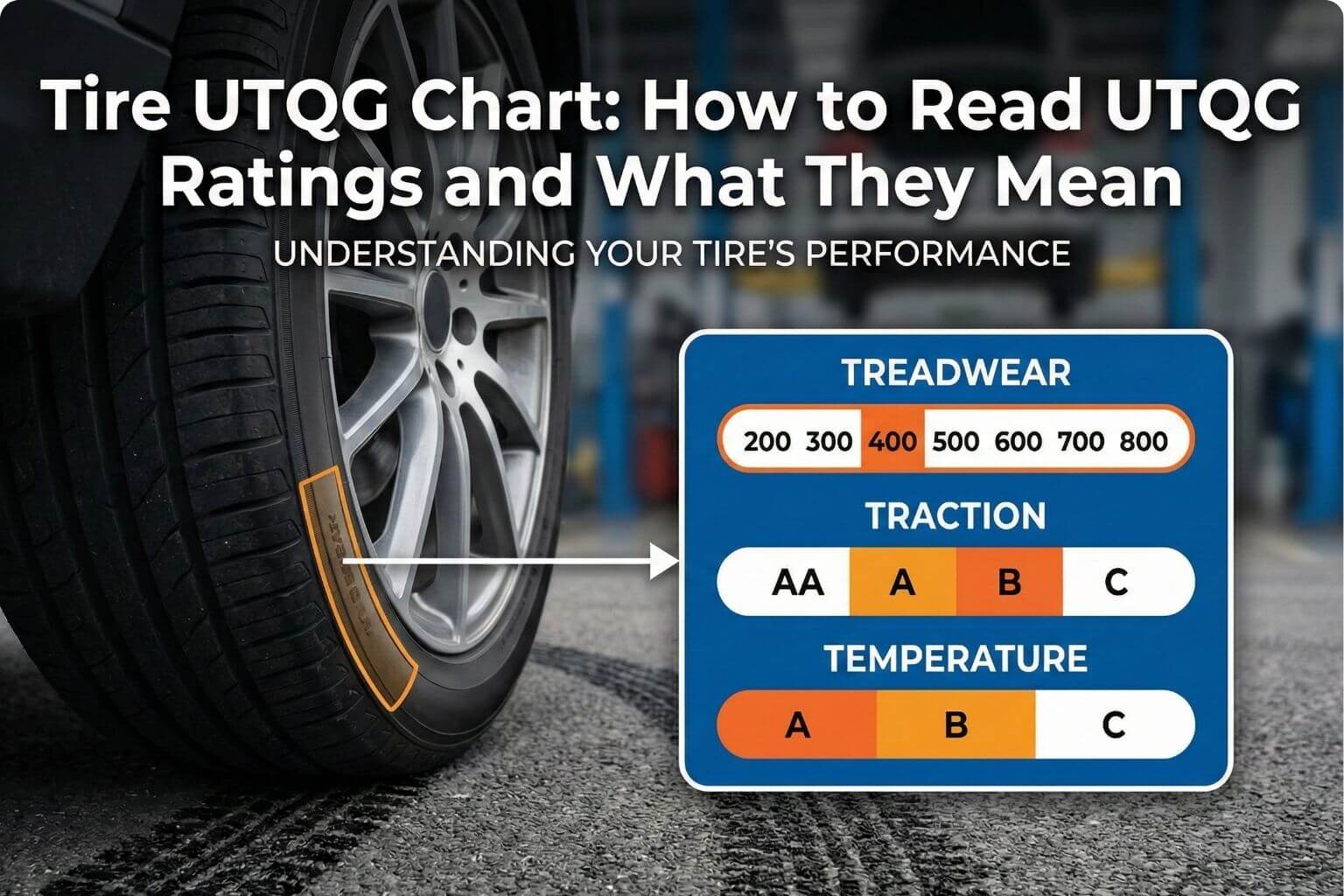
UTQG stands for Uniform Tire Quality Grading. It’s a rating system that helps you compare how long a tire will last, how well it grips the road when wet, and how well it handles heat.
You’ll usually see the UTQG rating printed on the side of a tire.
Here’s what each part means, explained in plain language:
1. Treadwear
- Treadwear is a number that tells you how long the tire is expected to last.
- A higher number means the tire should last longer.
- Example: A tire with 600 treadwear should last longer than a tire with 300.
2. Traction
- Traction is a letter grade that shows how well the tire grips wet roads.
- It measures stopping power during sudden braking on wet pavement.
- Grades go from best to basic: AA → A → B → C.
3. Temperature
- Temperature is a letter grade that tells you how well the tire handles heat.
- Heat can build up in tires during long drives or fast speeds.
- Grades go from highest to lowest: A → B → C.
The Tire UTQG Chart
Below is a practical, easy-to-scan UTQG chart you can use while comparing tires.
| UTQG Element | Typical values | What it means in practice |
| Treadwear | 200–400 | Performance-oriented tires (softer compound) — shorter lifespan but better grip in many cases |
| Treadwear | 400–700 | Mid-range — balanced life and performance for everyday driving |
| Treadwear | 700+ | Long-life commuter tires (harder compound) — longer tread life, sometimes less grip in extreme conditions |
| Traction | AA | Highest wet traction in UTQG tests (best stopping on wet surfaces) |
| Traction | A | Good wet traction for most passenger tires |
| Traction | B/C | Acceptable to lower wet traction — may be seen on some specialty or economy tires |
| Temperature | A | Best heat resistance (suitable for sustained highway speeds) |
| Temperature | B | Satisfactory for most passenger uses |
| Temperature | C | Lowest UTQG temperature rating — may be acceptable for lower-speed or specialty tires |
Tip: Treat the treadwear number as a relative comparison between two tires from different lines or brands, not as a promise of exact miles.
How to use the UTQG chart when buying tires
- Decide your priority: longevity, wet traction, or heat resistance.
- Use treadwear to narrow choices: pick a treadwear range consistent with your needs (e.g., 400–700 for balanced life). Remember this is relative.
- Check traction for safety in wet conditions: prefer A or AA if you regularly drive in rain.
- Consider temperature grade for long highway trips or hot climates: A-rated temperature resistance is preferable.
- Look at the whole picture: UTQG + manufacturer specs + third-party reviews = best choice.
Short scenarios
- Commuter in city: Prioritize 600–900 treadwear, traction A, temperature B or A.
- Performance driver / track-day: Lower treadwear (200–400) with AA/A traction; you’ll trade life for grip.
- Hot-climate highway driver: Prioritize temperature A and treadwear 500+ if you want longevity at speed.
- SUV / light truck use: UTQG applies to passenger tires — for heavy off-road or truck tires, check manufacturer and load ratings in addition to UTQG.
Common Misconceptions About UTQG Ratings
Many shoppers misunderstand what UTQG ratings really mean. Here are some of the most common mistakes people make—and the simple truth behind them.
1. “A higher treadwear number means the tire will last a certain number of miles.”
This is not true.
A treadwear number is only a comparison, not a guarantee.
For example, a tire with a treadwear of 600 does not promise 60,000 miles. It simply means it should last longer than a tire with a treadwear of 300 when tested under the same conditions.
Simple takeaway:
Higher number = longer potential life, but not a set mileage.
2. “All brands measure UTQG the same way.”
They don’t.
Each manufacturer runs its own tests, so two different brands with the same UTQG rating may still perform differently in real life.
Simple takeaway:
Use UTQG for rough comparison, not exact matching between brands.
3. “Better traction or temperature grades always mean a better tire.”
Not always.
A tire with top traction might wear out faster because the rubber is softer. And a tire with a high temperature grade may not be necessary for slow, city driving.
Simple takeaway:
The “best” rating depends on your driving needs, not the highest letter.
4. “UTQG tells you everything about a tire.”
UTQG covers only three things: treadwear, traction, and temperature.
It does not tell you about:
- comfort
- noise
- snow or ice performance
- handling
- fuel efficiency
Simple takeaway:
Check reviews and descriptions—UTQG is only one part of the picture.
5. “All tires have UTQG ratings.”
Not true.
Some tires, like winter tires and some off-road tires, don’t use UTQG ratings at all.
Simple takeaway:
Don’t worry if specialty tires don’t list a UTQG number.
UTQG vs Real-World Performance
UTQG ratings are helpful, but they don’t always tell the full story. In real everyday driving, some tires may perform differently than their numbers suggest. Here’s why.
Why Some High-Performance Tires Have Lower UTQG Grades
High-performance tires are designed for maximum grip, especially at high speeds or sharp turns. To do this, they use softer rubber that sticks better to the road.
But softer rubber usually means:
- The tire wears out faster → lower treadwear number
- The focus is on grip, not long life
So a high-performance tire might have a treadwear rating like 200, while a regular commuter tire might be 600 or more.
This doesn’t mean the performance tire is “bad.” It simply means it sacrifices lifespan for better traction and handling.
Simple takeaway:
Low treadwear on a performance tire = strong grip, shorter life.
High treadwear on a regular tire = longer life, less sporty feel.
Why UTQG Ratings Vary Between Manufacturers
Even though UTQG is a standardized system, each tire brand tests its own products. That means:
- Not all tests are done in exactly the same way
- Different companies may use different test tracks or conditions
- A treadwear “400” from one brand may not wear exactly the same as a “400” from another brand
Because of these differences, UTQG should be used as a general guide, not a perfect comparison.
Simple takeaway:
UTQG numbers are helpful, but they’re not identical across brands. Always look at reviews and real-world feedback too.
Putting It All Together
UTQG can help you compare tires, but it shouldn’t be the only thing you rely on.
For the best decision:
- Use UTQG to understand basics like tread life and grip
- Check reviews or road tests for real-world performance
- Choose the rating that fits your driving style and daily needs
Which UTQG Ratings Are Best for You — Quick Buyer Personas
Below are short, simple profiles that match common drivers. For each one I list the UTQG ranges to look for and a plain-English reason why.
1) Daily Driver / Commuter
Look for: Treadwear 400–700, Traction A, Temperature A or B
Why: You want tires that last a long time and handle normal wet roads. This range balances life and grip without costing too much.
Shopping tip: If you mostly drive city and highway at moderate speeds, prioritize higher treadwear.
2) Performance Driver (sporty handling, fast cornering)
Look for: Treadwear 200–400, Traction AA or A, Temperature A
Why: Sport tires use softer rubber for better grip and handling. That gives great cornering and braking but shorter life.
Shopping tip: Expect to replace these tires sooner — pick a brand known for strong wet braking if you drive in rain.
3) SUV / Light Truck Owner (everyday use)
Look for: Treadwear 500–800, Traction A, Temperature A or B
Why: SUVs are heavier; you’ll want tougher tread so tires last under load and during long drives.
Shopping tip: Also check the tire’s load rating (separate from UTQG) to make sure it matches your vehicle and cargo.
4) Rainy-Climate Driver
Look for: Traction AA or A, Treadwear 400–600, Temperature A or B
Why: Wet stopping is the priority. Higher traction grades help reduce stopping distance in heavy rain.
Shopping tip: If you choose a very soft, high-grip tire, expect faster wear — balance traction with a reasonable treadwear number.
5) Long-Distance / Highway Driver (lots of miles)
Look for: Treadwear 600–900+, Traction A, Temperature A
Why: You need long-lasting tires that resist heat and wear on long trips. High treadwear numbers usually last longer.
Shopping tip: Look for mileage warranties and good temperature grades for hot-road durability.
6) Budget-Conscious Shopper
Look for: Treadwear 400–700, Traction A or B, Temperature B
Why: Aim for a reasonable mix of life and safety without paying for niche features you won’t use.
Shopping tip: Read owner reviews to confirm real-world longevity — UTQG helps, but reviews show how a tire actually wears.
Quick, simple checklist to pick the right UTQG for you
- What matters most: life, wet stopping, or heat resistance? (Choose treadwear, traction, or temperature accordingly.)
- Match the recommended ranges above to your driving style.
- Always check load/speed ratings, warranty, and user reviews — UTQG is only part of the picture.
- Remember: winter tires and some specialty tires may not have UTQG ratings.
Final Tips for Choosing Tires Using UTQG Ratings
Here are short, simple tips you can use when shopping for tires. No jargon — just quick actions that help you pick smarter.
- Use UTQG as a guide, not a rule.
Treat the numbers and letters as helpful hints about life, wet grip, and heat resistance — not promises. - Decide what matters to you first.
Do you want long life (treadwear), strong wet braking (traction), or heat resistance for long highway drives (temperature)? Pick the rating to match that priority. - Compare similar tires.
Put tires from the same category side-by-side (commuter vs. performance). UTQG is most useful when you compare like with like. - Watch the trade-offs.
Higher traction often means softer rubber and faster wear. Higher treadwear often means firmer rubber and less grip. Choose the trade-off you’re willing to accept. - Check load and speed ratings too.
UTQG doesn’t show how much weight a tire can carry or its safe speed. Always confirm the load and speed numbers for your vehicle. - Read real-world reviews and tests.
UTQG gives basic facts. User reviews and independent tests fill in comfort, noise, snow performance, and how the tire actually wears. - Look at warranties and mileage guarantees.
A mileage warranty can give a clearer idea of expected life than a single treadwear number. - Remember climate matters.
If you live somewhere hot, prefer higher temperature grades. If you drive in heavy rain, prioritize traction. Winter tires may not have UTQG ratings — that’s okay. - Check the sidewall or product page.
You’ll usually find UTQG printed on the tire sidewall or listed on the product page. Make sure you’re reading the right values (treadwear = number; traction & temperature = letters). - Ask a pro when unsure.
If you’re still unsure, a tire shop or mechanic can explain how a specific tire will work on your vehicle and for your driving style.
Frequently Asked Questions (FAQ)
Are UTQG numbers the same across brands?
No — UTQG is comparative. Use it to compare tires but consult reviews and warranties as well.
Does a higher treadwear number mean better grip?
Not necessarily. Higher treadwear usually indicates a harder compound and longer life, which can reduce ultimate grip compared to softer, lower‑rating performance tires.
Should I pick AA traction always?
AA is best for wet traction, but it’s not necessary in all cases. If you live in a dry climate and prioritize long life, a traction A tire can be perfectly suitable.
Is UTQG mandatory?
UTQG labelling is standard for passenger tires in markets that use it, but it’s best used as one data point among many.
